









Electric underfloor heating: warmth from below, in every room
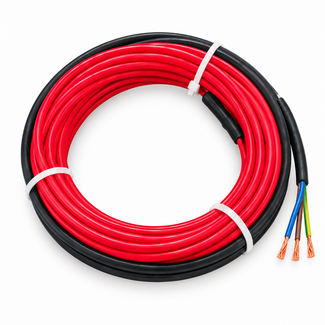
Electric underfloor heating consists of thin heating cables or foil that you lay directly under the floor finish. A thermostat with a floor probe controls the temperature. Because there are no water pipes or manifold, the floor build-up is only a few millimetres thick. That makes it ideal for renovations: you lay it on the existing floor, without digging up the screed and without touching your central heating system.
Use it as comfort heating for warm feet, or as primary heating in a well-insulated room. Want to know exactly what happens inside the floor? Read how electric underfloor heating works.
What types of electric underfloor heating are there?
The main choice is mat or foil. That mostly depends on your floor finish: will the floor be bonded down, or will a floating floor go on top?
| System | Output | Suitable for | Floor build-up |
|---|---|---|---|
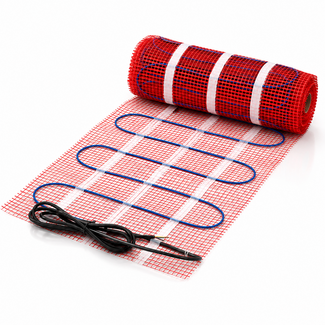
| Heating mat (Pro-Series, Red Series, Magnum) | 150 or 200 W/m² | Tiles, natural stone, poured floors and bonded floors | Mat fully embedded in tile adhesive or levelling compound |
| Heating mat Green Line | 100 W/m² | Rooms with a lower heat demand | Mat fully embedded in tile adhesive or levelling compound |
| Heating foil | 150 W/m² | Laminate, click vinyl and floating engineered wood | Floating, on a suitable underlay |
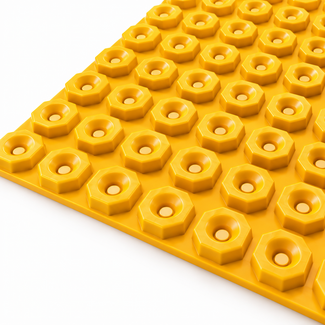
| Decoupling kit | approx. 115, 150 or 230 W/m² | Tiles on a moving or difficult subfloor | Loose cable in a decoupling membrane |
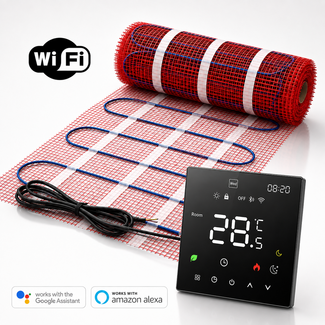
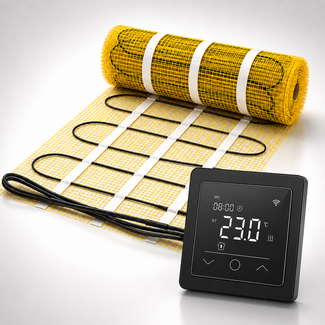
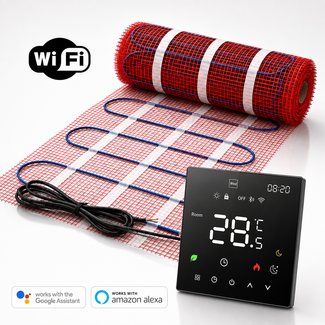
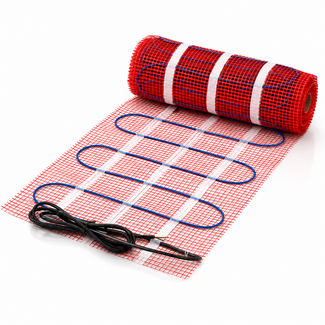
Electric underfloor heating mats are the most popular choice. The Pro-mat Pro-Series is only 3 mm thick, including the mat, so the floor height barely changes. Torn between brands? Read Pro-mat vs Magnum or the overview of all types of electric underfloor heating. Want to get everything right in one go? Choose a complete underfloor heating kit with mat, thermostat and probe.
Electric underfloor heating under laminate, vinyl, wood or tiles
Electric underfloor heating works under almost any floor, as long as the floor finish and underlay are approved for it. Each floor type has its own point to watch:
- Tiles and poured floors: the best heat transfer. Lay a heating mat in the tile adhesive or levelling compound.
- Laminate: choose heating foil on a suitable underlay, or a mat in levelling compound. Stay within the laminate's maximum temperature.
- LVT and vinyl: click vinyl can go on foil. Never glue vinyl directly onto heating foil: that needs an approved floor build-up with an intermediate layer. We do not sell these boards and they are not included with the foil. Have your build-up assessed before you order.
- Wood: floating engineered wood can go on foil, provided it is suitable for underfloor heating. Watch out for moisture and the maximum floor temperature.
- Carpet: possible, but the combined tog value of carpet and underlay must be low enough to let the heat through.
Electric underfloor heating by room
In the living room you usually choose a larger area and 150 W/m². In a well-insulated living room it can then also serve as primary heating. It is also a practical solution in the kitchen, bedroom, loft or home office. You only heat the room you are using, with a separate thermostat for each room.
Which output suits your room?
| Output | When to choose it |
|---|---|
| 100 W/m² | Comfort heating in a well-insulated room, for warm feet |
| 150 W/m² | The standard: comfort or primary heating in a well-insulated room |
| 200 W/m² | Faster warm-up, or a room with more heat loss such as a conservatory or extension |
A higher output does not automatically make a room suitable for primary heating. Whether it is enough depends on the room's heat loss. Work with the net heated area: the floor without fitted units and kitchen cabinets.
How much does electric underfloor heating cost?
The purchase price depends on the system, the number of square metres and the thermostat. Add insulation, levelling compound and installation where needed. You will find kits by floor area under underfloor heating per m², and more about prices in how much electric underfloor heating costs.
You work out the electricity use like this: output in watts ÷ 1,000 × the number of hours the heating is actually on. A 150 W/m² mat uses 0.15 kWh per m² for one hour at full output. The thermostat switches off in between, so actual use depends on insulation, settings and the outdoor temperature. You will find more worked examples in how many kWh electric underfloor heating uses and the comparison electric underfloor heating vs gas.
Insulation: faster warm-up and lower running costs
On a cold concrete floor, part of the heat is lost downwards. With insulation boards under the heating, the floor warms up faster and you use less electricity. On insulation, a floor is often warm within 15 to 30 minutes; on bare concrete it can take well over an hour. Read more in insulation under electric underfloor heating.
Thermostat and wiring
Every electric underfloor heating system needs a thermostat with a floor probe. With a WiFi thermostat you set a programme for each day and control the heating from your phone. Check the switching capacity: a 16 A thermostat is suitable up to about 3,500 W, for larger areas you choose a 25 A thermostat or a load module. In the UK, smaller systems can often run from a fused spur, larger ones need a dedicated circuit from the consumer unit. How to calculate the load and when you need a separate circuit is explained in our guide how to wire electric underfloor heating.
Installing electric underfloor heating yourself
You can easily install electric underfloor heating yourself, using the step-by-step guide. Measure the resistance of the mat before, during and after laying, and have the electrical connection made by a qualified electrician. Only switch the heating on once the adhesive and levelling compound have cured according to the manufacturer's instructions. The video shows how the installation works in practice.
What are the pros and cons of electric underfloor heating?
Electric or wet underfloor heating? Both have their place. Electric underfloor heating is strongest in renovations and single rooms, a wet system in new builds with a heat pump.
Pros
- Quick and thin: a mat can be laid in a day and raises the floor by only a few millimetres.
- No major works: no pipes, no manifold and no changes to your boiler.
- Room-by-room control: each room gets its own thermostat, so you only heat what you use.
- Maintenance-free: no bleeding, no leaks, no pump.
- Lower purchase cost: usually cheaper than wet underfloor heating, especially for one or two rooms.
Cons
- Running costs: if you heat a large, poorly insulated area for long periods, electricity use goes up.
- Not always suitable as the only heat source: rooms with a lot of heat loss need extra heating.
- Floor requirements: not every floor finish and underlay is approved for underfloor heating.
Still in doubt? Read the disadvantages of electric underfloor heating, is electric underfloor heating cost-effective? and electric underfloor heating or a heat pump.
What warranty do you get on electric underfloor heating?
Our heating mats come with a lifetime warranty. You activate it by completing the warranty form in full and sending it to us. Thermostats, probes and all other products carry a 2-year warranty. This does not affect your statutory rights.
To make sure you are covered if you ever need to make a claim:
- Measure the resistance of the mat before, during and after laying, and write down the readings.
- Take photos of the laid mat before the floor finish goes on.
- Follow the installation instructions and have the connection made by a qualified electrician.
- Keep your invoice and the completed warranty form.
Want to know how long a mat lasts in practice? Read how long electric underfloor heating lasts.
How do you choose the right electric underfloor heating?
You choose the right electric underfloor heating based on your floor and your room. Start with the floor finish: for tiles or a bonded floor you choose a mat, for floating laminate, click vinyl or engineered wood you choose foil. Then measure the net heated area, so without fitted units and kitchen cabinets. The output depends on the insulation and on what you want: comfort heating or primary heating. For that you choose 100, 150 or 200 W/m². Next, choose a thermostat with a floor probe that matches the total load. Laying on concrete? Then use insulation boards, so the floor warms up faster and you use less electricity.
Already know your floor area? Then choose a kit straight away under underfloor heating per m². Prefer personal advice? Get in touch with us, we are happy to help.