

How does electric underfloor heating work?
Electric underfloor heating is becoming increasingly common in Dutch homes. In the bathroom, the kitchen, sometimes throughout the house. But how does the system actually work? What is under that floor, what exactly does the thermostat do and which floor is suitable for it? In this blog we explain it from front to back, so that you know exactly where you stand.
What is electric underfloor heating?
Electric underfloor heating is a heating system in which electric cables or heating mats are installed under the floor. These elements convert electricity into heat, making the floor feel warm and gradually warming the room.
The big difference with a traditional radiator? A radiator heats the air at one point in the room. Underfloor heating spreads the heat evenly over the entire floor, from wall to wall. The result is a comfortable indoor climate without cold corners or drafty heat flows along the ceiling.
How does the system work step by step?
The principle is simpler than you might think:
- The thermostat measures the desired temperature
- The floor sensor monitors the current floor temperature
- The system is receiving power
- The heating cables or mats become warm
- The heat rises evenly from the floor
- The room reaches a constant, comfortable temperature
That's it. No complex installation, no major interventions in the home. Just heat from below.
The most important parts
To understand how electric underfloor heating works, it helps to know the parts.
| Part | Function | Why important? |
|---|---|---|
| Heating cable or mat | Converts electricity into heat | Provides the actual heating |
| Thermostat | Regulates the temperature | Keeps energy consumption under control |
| Floor sensor | Measure the floor temperature | Prevents overheating |
| Insulating layer | Limited heat loss downwards | Increases efficiency by up to 30% |
| Power supply | Supplies electricity to the system | Necessary for operation |
How does the thermostat work?
The thermostat is the brain of the system. You set the desired temperature and the thermostat automatically determines when the heating should be turned on or off. Simple to use, but a big difference in energy consumption if you set it smartly.
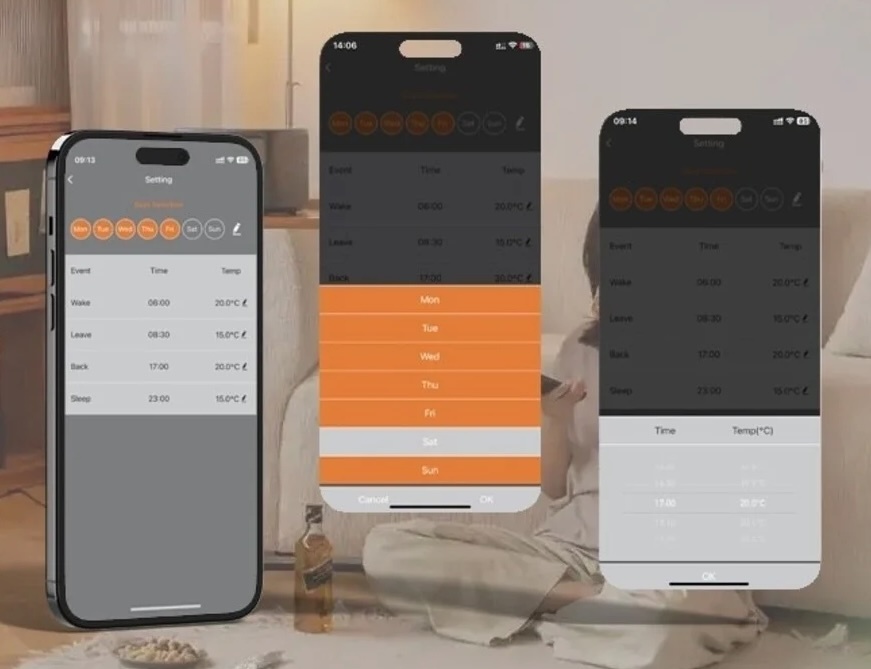
Modern thermostats are programmable or work via WiFi. This way you can regulate the temperature per room and set a schedule that suits your day. No one home during the day? Then the heating is simply turned off.
Our PS60 thermostat goes one step further. It has an open window function: as soon as the temperature drops quickly due to an open window or door, the heating switches off automatically. This way you don't heat outside without having to think about it yourself.
Smart functions of modern thermostats:
- Set weekly program
- Control via smartphone
- Automatic energy saving
- Open window detection
- Insight into energy consumption
How does the floor sensor work?
The floor sensor continuously measures the temperature of the floor. If the floor becomes too warm, the sensor sends a signal to the thermostat to temporarily switch off the heating. That sounds technical, but the practical benefits are clear: the floor never overheats, you do not consume unnecessary electricity and sensitive floor types such as PVC and laminate remain protected. The sensor plays a small but important role in the whole.
What types are there?
Not every room requires the same system. These are the three most commonly used versions:
Heating mats
The heating cable is already incorporated in a mat. Roll out, secure and level. Popular for renovations because installation is quick and requires little installation height. Ideal for bathrooms, kitchens and small spaces. View our range of heating mats.
Loose heating cables
More flexibility, more options. Loose cables adapt more easily to spaces with a different shape. Often used in larger spaces and new construction projects.
Foil heating
Extremely thin, dry installation and quickly laid. Foil heating is installed under floating floors such as laminate or click PVC. Useful if the installation height is limited or if you do not want to level.
How quickly does it heat up?
This depends on the type of system, the insulation under the floor, the floor finish and the capacity per m². On average, it takes between 20 minutes and 2 hours for the floor to reach full temperature.
A well-insulated floor heats up faster and retains heat longer. This is where the biggest benefit lies: good insulation is not a nice extra, it largely determines how efficiently the system works.
Which floor is suitable?
| Floor type | Suitable? | Heat conduction |
|---|---|---|
| Tiles | Yes | Very good |
| PVC | Yes | Very good |
| Laminate | Yes | Good |
| Cast floor | Yes | Good |
| Wood | Limited | Depending on thickness |
| Carpet | Sometimes | Less suitable |
Tiles and PVC conduct heat by far the best. When it comes to wood and carpet, always check the manufacturer's specifications before making a choice.
Is electric underfloor heating economical?
Honest answer: that depends on how you use it and how well the floor is insulated. The system is very efficient as additional heating in a well-insulated room. As main heating in a poorly insulated home, consumption can be disappointing. The biggest lever is in the insulation under the underfloor heating. With Pro-Board insulation plates directly under the heating mat, efficiency increases by up to 30%. The heat goes in the right direction and the system doesn't have to work as hard to get up to temperature.
These factors also play a role:
- Insulation of the home
- Using a smart thermostat
- Size of the room
- Electricity rate
- Number of hours of use
Do you have solar panels? Then electric underfloor heating becomes extra interesting. You then heat largely on your own generated electricity, which significantly reduces the monthly costs. Read more about the costs in our blog about what electric underfloor heating costs.
Advantages and disadvantages at a glance
Benefits:
- Quick and easy installation
- Low installation height
- Comfortable, even heat distribution
- No visible radiators
- Hardly any maintenance
- Adjustable per room
- Suitable for renovation
Disadvantages:
- Higher energy costs with intensive use and poor insulation
- Less suitable as main heating in poorly insulated homes
- Depending on the electricity price
The disadvantages can largely be limited with good insulation and a smart thermostat. That makes the choice for electric underfloor heating sensible in most situations.
When is it a good choice?
| Situation | Why suitable? |
|---|---|
| Bathroom renovation | Fast heating and easy installation |
| Small spaces | Lower installation costs, high comfort |
| Well insulated house | Lower energy consumption |
| Additional heating | Extra comfort in addition to existing heating |
| Houses with solar panels | Smart use of self-generated electricity |
Conclusion
Electric underfloor heating works via heating cables or mats under the floor, controlled by a thermostat and monitored by a floor sensor. The system is comfortable, easy to install and affordable if used wisely.
Do you want to know which system best suits your space and situation? Use our calculation tool and receive appropriate advice immediately. Or view our installation guide if you already know what you want and want to get started right away.
